
What began as a viral internet meme has officially spilled onto the concrete of New Delhi. On Saturday, June 6, 2026, the national capital witnessed a historic paradigm shift in youth activism. In a defiant show of strength, thousands of students, aspirants, and citizens gathered at the historic protest ground of Jantar Mantar. The message was loud, clear, and unyielding: the youth will no longer be ignored.
Marking a monumental transition from online satire to tangible grassroots mobilization, CJP Stages First Major Street Protest to challenge the deep-seated irregularities plaguing India’s national examination framework. Carrying paper cockroach masks, books, and national flags, the young demonstrators transformed public anger over paper leaks and systemic academic failures into a highly visible movement.
The Genesis: How an Insult Spawned a Movement
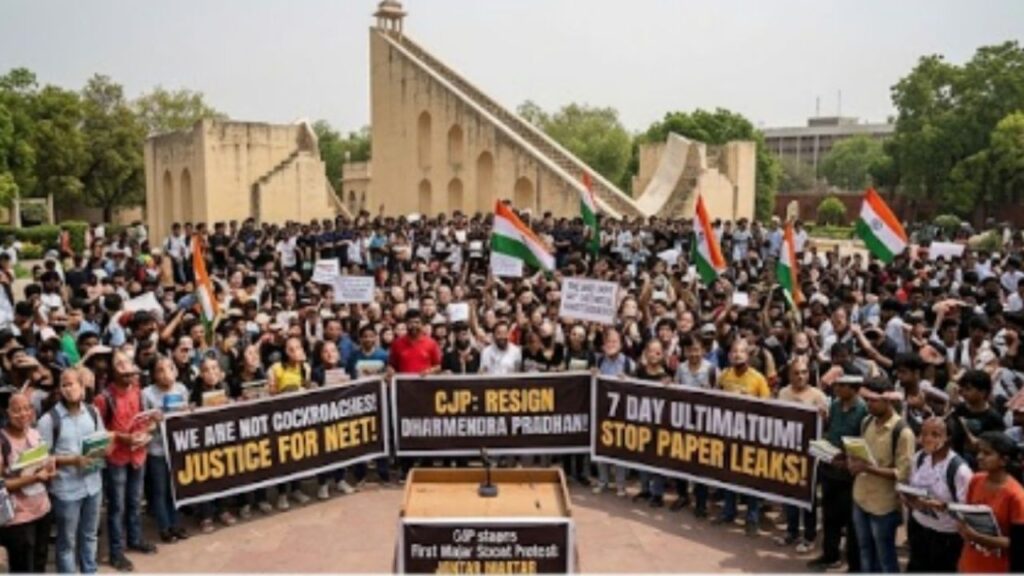
To understand why CJP Stages First Major Street Protest, one must look back at how the Cockroach Janta Party (CJP) was born. The movement emerged as a direct response to a controversial remark made during a Supreme Court hearing, where critics and unemployed youth were likened to “cockroaches.”
Instead of backing down, India’s Gen-Z and millennial population weaponized the insult. Led by 30-year-old political communications strategist and Boston University student Abhijeet Dipke, the satirical concept exploded. Within weeks, the CJP amassed over 22 million followers on Instagram, outstripping established political entities and capturing the collective frustration of a generation battling:
- A staggering 40% unemployment rate among graduates under 25.
- Systemic, recurring leaks of crucial national examination papers (including NEET-UG and CUET).
- Deep anxieties regarding the integrity of the CBSE On-Screen Marking (OSM) system.
As internet-driven anger reached a boiling point, the virtual realm proved insufficient. To demand absolute accountability, on-ground action became inevitable, which is why CJP Stages First Major Street Protest at the heart of India’s political capital.
From URL to IRL: The Scene at Jantar Mantar
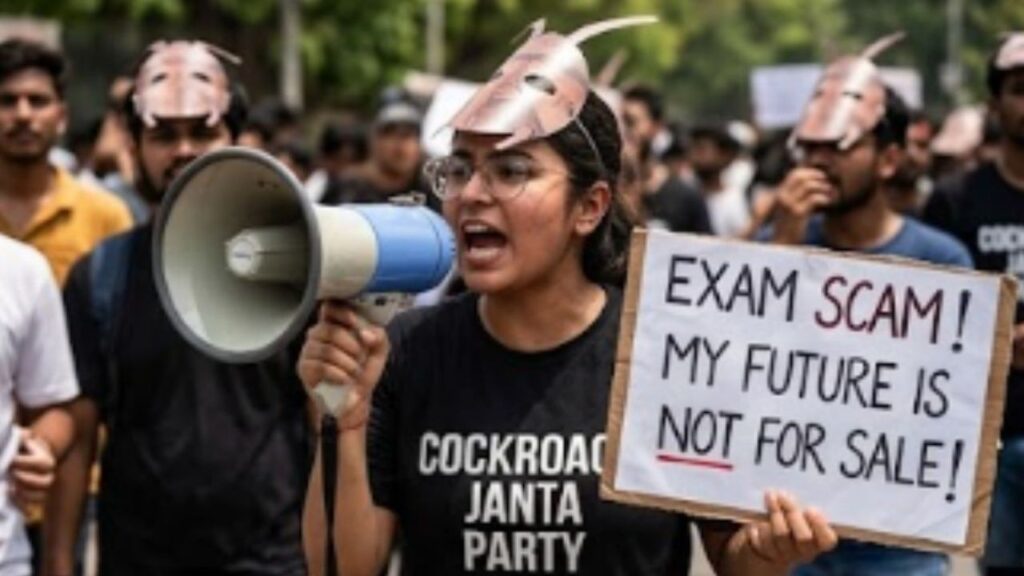
The energy at Jantar Mantar was electric, marked by an intersection of digital subculture and raw, democratic protest. As CJP Stages First Major Street Protest, the venue filled with high schoolers, competitive exam aspirants, and concerned parents who traveled overnight from various corners of the country.
Many protesters held up signs reading “I am a Cockroach” alongside demands for the immediate resignation of Union Education Minister Dharmendra Pradhan. The atmosphere was a mix of peaceful dissent and deep-seated grievance. For the vast majority of young attendees, this was their first time participating in a street demonstration—driven not by career politicians, but by shared anxiety over their educational futures.
As CJP Stages First Major Street Protest, the heavily deployed Delhi Police set up multi-layered steel barricades. Despite the sweltering 40°C heat and intense security scrutiny, the “swarm” stood its ground, signaling that the digital generation is fully prepared to handle the friction of real-world activism.
Analytical Breakdown of the Protest Logistics
While the symbolic victory of the protest is undeniable, the transition from an online space to a chaotic physical venue highlighted critical operational lessons. Examining these logistical dynamics reveals the growing pains of a rapidly scaling youth movement.
| Logistical Factor | Challenges Faced | Strategic Outtakes |
| Crowd Management | Shifting instructions from Parliament Street Police Station to Jantar Mantar caused initial directional confusion. | Real-time digital updates require clear, static on-ground marshals to guide large crowds seamlessly. |
| Audio Infrastructure | A standard handheld microphone and late-assembled stage struggled to project over public address systems. | Transitioning to major public grounds requires heavy-duty audio setups to maintain absolute crowd cohesion. |
| Volunteer Presence | Lack of structural crowd-management split the gathering into smaller, independently chanting factions. | Decentralized movements require trained volunteer units to sync chanting, safety protocols, and media interactions. |
| Resource Supply | Extreme 40°C summer heat led to local shops rapidly running out of drinking water stocks. | Future major rallies must feature dedicated hydration and medical first-aid stations managed by internal teams. |
As CJP Stages First Major Street Protest, these operational bottlenecks demonstrated that navigating state machinery requires structured, institutional planning alongside viral social media reach.
The Political Stakes and National Implications
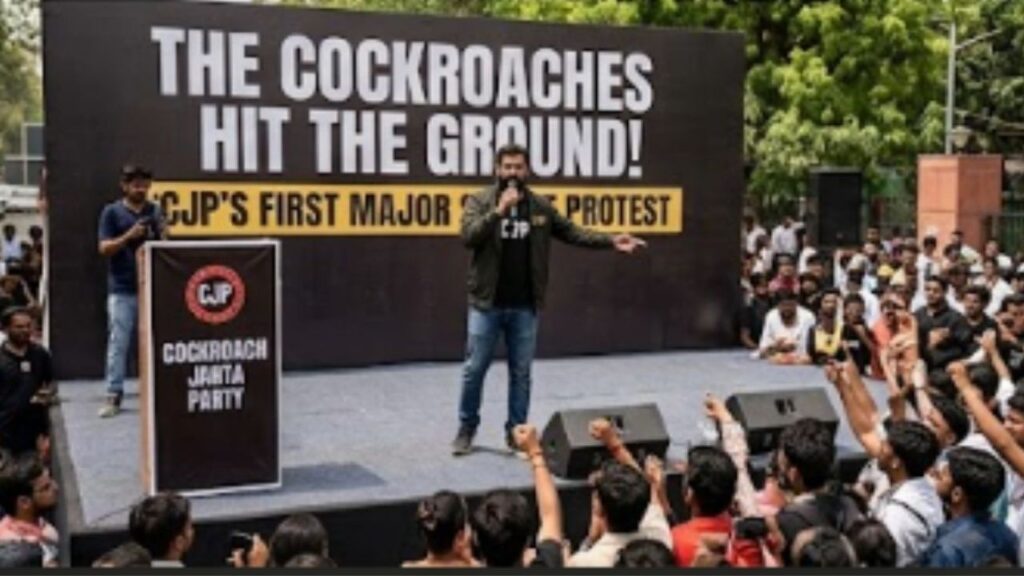
By focusing heavily on structural issues like unemployment and exam corruption, the CJP has struck a sensitive chord. The government’s decision to block the movement’s X account in India on national security grounds—a move currently being challenged in the Delhi High Court—proves that the administration views this youth block as a formidable dissenting voice.
By bringing thousands out to the streets, CJP Stages First Major Street Protest effectively changes the narrative. It moves the conversation away from standard partisan politics and firmly anchors it to the material security of India’s youth.
What Lies Ahead: A 7-Day Ultimatum
The Jantar Mantar demonstration was not a one-off event; it was a warning shot. Following the successful gathering where CJP Stages First Major Street Protest, Abhijeet Dipke issued a strict seven-day ultimatum to the central government demanding the resignation of Education Minister Dharmendra Pradhan.
The group’s leadership—including official spokespersons Saurav Das, Vijeta Dahiya, and Ashutosh Ranka—has announced plans to expand the agitation. If their demands are not met within the stipulated week, the CJP plans to decentralize its operations, taking coordination efforts to multiple tier-2 and tier-3 cities across India. This strategy aims to ensure that the momentum built in New Delhi expands into a nationwide campaign for absolute educational reform. First Major Street Protest
The NTA Integrity Crisis: The National Testing Agency (NTA), responsible for conducting massive entrance exams like NEET-UG (for medical aspirants) and CUET (for university admissions), faced unprecedented scrutiny over structural vulnerabilities. Rumors of paper leaks, grace marks arbitrarily awarded, and systemic center-level rigging shattered public trust. For a student who spends 14 hours a day for three years preparing, a leaked paper feels like an absolute theft of their future.
The CBSE OSM (On-Screen Marking) Controversy: Beyond entrance exams, high schoolers were triggered by alleged anomalies in the CBSE’s digital evaluation process. Students who scoring consistently in the high 90s suddenly received failing marks in specific subjects, leading to allegations of massive software glitches and negligent evaluation pipelines. First Major Street Protest
The Unemployment Paradox: India is currently experiencing a demographic dividend, but graduate unemployment sits at a perilous high. The frustration at Jantar Mantar wasn’t just about an exam; it was about the collective realization that even playing by all the rules and acing the tests no longer guarantees financial security
De-radicalizing Dissent: Traditional protests in India are often highly polarized along caste, religious, or partisan lines. By branding themselves around a literal insect—the “Cockroach”—the movement created a neutral, universally accessible identity. A student from Bihar, an aspirant from Rajasthan, and an activist from Delhi could all unite under a ridiculous, self-deprecating banner without carrying old political baggage. First Major Street Protest
Algorithmic Warfare: Traditional political parties rely on massive ground machinery and paid media to get their message out. The CJP utilized internet humor, viral Instagram reels, and relatable memes. This forced social media algorithms to push their content organically to millions of teenagers and young adults daily, bypassing mainstream media gatekeepers completely. First Major Street Protest
The Cross-Ideological Solidarities and Mainstream Political Backup
What started as a highly localized student gathering quickly expanded into a rallying point for India’s major opposition forces. As First Major Street Protest, several prominent national politicians broke their silence to express explicit solidarity, significantly elevating the political stakes of the demonstration:
- The Opposition Rallies Behind the ‘Swarm’: Former Delhi Chief Minister Arvind Kejriwal vehemently criticized the ruling administration on social media, stating that the “cockroach movement” is a direct expression of raw youth anger. He publicly urged the Prime Minister to sack the Education Minister immediately rather than branding dissenting students as anti-national.
- Regional Heavyweights Weigh In: Shiv Sena (UBT) chief Uddhav Thackeray issued a stern public warning to the central government via social media, explicitly advising them not to “underestimate the cockroach.” He emphasized that young students are protesting in the scorching 40°C heat because their careers have been fundamentally disrupted by the NEET paper leaks.
- National Level Alliances: High-profile civil rights figures and organizations, including activist Sonam Wangchuk and members of the CPI, openly extended their support. The presence of mainstream leaders at Jantar Mantar effectively shielded the young protestors, forcing the national media to give prime-time coverage to a movement that began entirely as an internet meme.
High-Stakes Security Deployments and Ground Detentions
The sheer digital scale of the CJP forced law enforcement to treat the Jantar Mantar event with an extreme level of caution, resulting in heavy security friction on the day CJP Stages First Major Street Protest:
- A Preemptive Fortress: Even before the demonstration officially kicked off, the Delhi Police deployed over 1,000 personnel, reinforcing strategic entry points, border checks, and the Indira Gandhi International Airport. Multi-layered steel barricades and water cannons were positioned across New Delhi to contain the influx of arriving students. First Major Street Protest
- The Airport Intercept: In a tense prologue to the demonstration, police officials met CJP founder Abhijeet Dipke directly at the airport upon his arrival from the United States. This prompted the CJP leadership to issue urgent, real-time routing updates, redirecting thousands of marching students to bypass the Parliament Street Police Station and head directly to the Jantar Mantar ground.
- Tactical Detentions: While the protest largely maintained a peaceful, disciplined atmosphere—with students carrying national flags and books—the situation grew highly volatile in the afternoon. Police officially detained at least six individuals to prevent a physical confrontation between opposing ideological student groups, proving just how fragile the peace was on the ground.
The Strategic Weaponization of Global Peace Symbols
Faced with massive police opposition, the First Major Street Protest used a highly unique tactical framework to completely disarm potential law enforcement crackdowns. As CJP Stages First Major Street Protest, the organizers implemented a strict code of non-violent, highly symbolic conduct that altered the typical optics of a street rally:
- Flowers for the Frontlines: Ahead of the march, Abhijeet Dipke issued an explicit directive on social media asking every single attendee to bring fresh flowers along with their books and national flags. Protestors were instructed to offer these flowers directly to the heavily armed Delhi police personnel as a concrete gesture of compassion, respect, and gratitude.
- Fasting As a Legal Deterrent: To insulate the core organizers from sudden police lockups or arbitrary charges, prominent activist Sonam Wangchuk announced a massive contingency plan: a six-week hunger strike if Dipke or any core youth representative were taken into permanent custody.
- The Symbolic Mask vs. The State: By wearing paper cockroach masks while performing peaceful actions, the students created an asymmetrical visual narrative. Any aggressive action taken by state authorities against a non-violent crowd carrying flowers and reading textbooks would have resulted in an absolute public relations disaster for the government. This clever tactical layering allowed the “swarm” to safely hold its ground.
Conclusion
The events at Jantar Mantar prove that digital momentum can successfully transform into political reality. When CJP Stages First Major Street Protest, it bridges the gap between internet satire and real-world democratic accountability. The transition was far from perfect—marked by audio issues, shifting timelines, and logistical hiccups—but the sheer presence of thousands of first-time protesters signifies a shifting tide in how India’s youth voices its dissent.
The “cockroaches” have officially left the digital walls and hit the ground. Whether this movement can sustain its momentum and force systemic policy changes remains to be seen, but one thing is certain: the political landscape of youth activism in India will never be the same again. First Major Street Protest
Frequently Asked Questions (FAQs)
1. What is the Cockroach Janta Party (CJP)?
The Cockroach Janta Party (CJP) is a prominent youth-led political movement in India. It began as a satirical online response to a court remark comparing critics to cockroaches, quickly evolving into a major advocacy platform for student rights, exam reforms, and employment opportunities.
2. Why did CJP stage a major street protest at Jantar Mantar?
CJP Stages First Major Street Protest primarily to demand the immediate resignation of Union Education Minister Dharmendra Pradhan over widespread irregularities, paper leaks, and evaluation discrepancies in major national exams like NEET-UG, CUET, and CBSE.
3. Who is leading the CJP movement?
The movement was founded by Abhijeet Dipke, a political communications strategist and graduate student. The organization has also appointed three official spokespersons to lead media communications: Saurav Das, Vijeta Dahiya, and Ashutosh Ranka.
4. What were the main challenges faced during the Jantar Mantar protest?
As CJP Stages First Major Street Protest, organizers faced logistical issues including sudden venue schedule shifts, inadequate sound amplification, a lack of ground volunteers to manage the crowd, and extreme 40°C summer heat with limited drinking water access.
5. What are the next steps for the CJP movement?
Following the day CJP Stages First Major Street Protest, the leadership issued a 7-day ultimatum for the education minister’s resignation. If unaddressed, the group plans to scale the agitation nationwide, organizing localized protests across multiple states and cities.