
The intersection of digital satire and real-world political activism reached a chaotic, historical boiling point at Shaheed Smarak in Jaipur, Rajasthan. What was originally designed as a high-volume, peaceful civil assembly organizing against massive structural anomalies in national competitive examinations rapidly mutated into a security crisis of national proportions. Within seconds of his arrival at the venue, a video went viral depicting the terrifying moments when the CJP founder slapped by multiple aggressive counter-protesters who had bypassed local law enforcement checkpoints. The shocking visual image of the young political leader being physically targeted while hoisted high upon the shoulders of his loyal student supporters instantly metastasized across digital ecosystems, shifting the public focus away from local administrative complaints into a raging firestorm regarding the physical safety of public dissenters in contemporary India.
The visual footage of the moment the CJP founder slapped multiple times serves as a graphic diagnostic index of the hyper-polarized state of student politics today. Rather than acting as an isolated incident of simple crowd friction, this calculated physical assault represents a much deeper structural rupture. It marks the intersection where digital satire, real-world grassroots mobilization, and intense ideological hatred collide. The sheer speed with which the news of the CJP founder slapped entered the national prime-time media broadcast cycle reveals an establishment intensely anxious about the disruptive capabilities of non-traditional, highly agile political startups that refuse to operate within the established boundaries of traditional electoral logic.
1. The Socio-Political Genesis of the Cockroach Janta Party (CJP)
To comprehensively deconstruct the systemic motivations behind the coordinated ambush where the CJP founder slapped, one must thoroughly examine the unconventional origins of the Cockroach Janta Party itself. The organization was conceptualized, built, and launched by Abhijeet Dipke, a thirty-year-old digital strategist, investigative journalist, and advanced public relations graduate from Boston University. The genesis of the CJP did not take place within traditional, smoke-filled backrooms of historic political machinations; instead, it emerged as a fiercely sophisticated, hyper-ironic digital counter-narrative against institutional arrogance and official apathy.
The foundational identity of the CJP was forged as a direct response to highly controversial remarks made within judicial and legislative chambers, where struggling, unemployed Indian youth and civil rights activists were dismissively labeled as “cockroaches” and “parasitic elements” disrupting economic growth. Rather than succumbing to institutional demoralization, Dipke skillfully turned this degrading terminology inside out. Utilizing state-of-the-art generative artificial intelligence imagery, cutting-edge memes, and relentless political irony, he institutionalized the CJP under the subversive, mock-humorous slogan: * “The Authentic Voice of the Lazy and Unemployed.”* Within mere weeks, this online portal attracted millions of young citizens who recognized their own existential economic anxieties mirrored in the party’s sharp satirical broadsides. However, as the continuous wave of competitive exam paper leaks derailed the lives of millions, the CJP transitioned from digital satire to aggressive street mobilization—a direct threat to entrenched power dynamics that eventually culminated in the hostile scene where the CJP founder slapped by counter-activists.
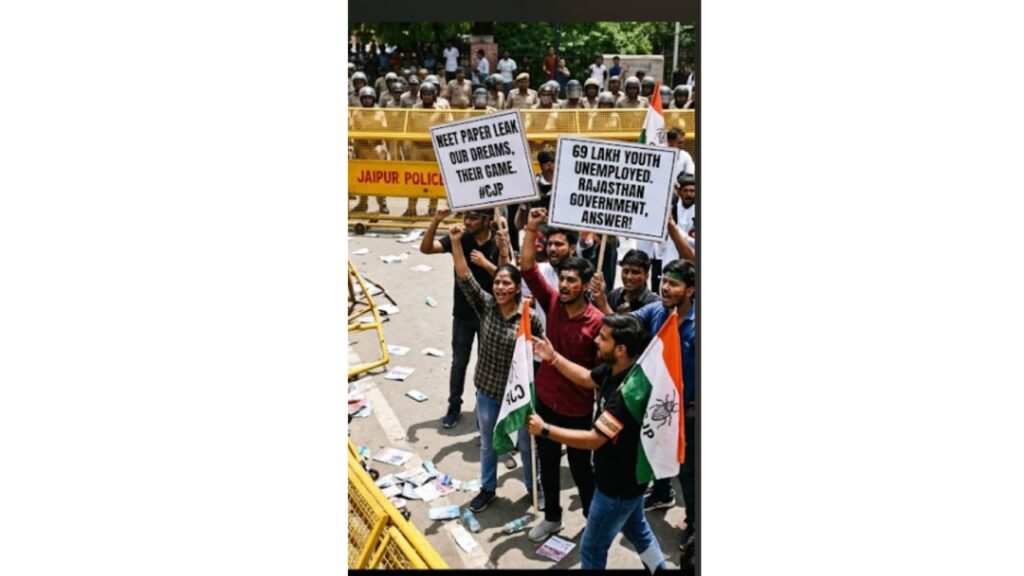
2. Anatomical Deconstruction of the Shaheed Smarak Assault
The logistical orchestration of the protest on June 15, 2026, at Shaheed Smarak was intended to display massive, peaceful solidarity against structural corruption within the National Eligibility cum Entrance Test (NEET-UG) and associated administrative frameworks. Thousands of students from coaching hubs across Kota, Jaipur, and Sikar had converged to demand systemic transparency. As the crowd swelled, Abhijeet Dipke arrived to deliver his keynote address. Due to the massive volume of individuals pressing forward, eager student volunteers hoisted Dipke upon their shoulders so he could be visible across the sprawling monument complex. It was precisely at this moment of maximum physical exposure that the security perimeter was completely compromised.
A group of five aggressive individuals, later identified by law enforcement as part of an organized counter-demonstration unit, rapidly cut through the uncoordinated student security line. The primary assailant lunged forward with extreme force, aggressively seizing Dipke’s signature maroon party scarf and dragging his upper body downward into the moving crowd. In a rapid succession of violent physical movements captured on high-definition smartphone cameras, the surrounding audience watched the CJP founder slapped four consecutive times directly across his face and neck. The physical impact almost dislodged Dipke from his supporters’ shoulders, causing immediate tactical panic among the civilian coordinators of the rally who scrambled to shield their leader from further injury.
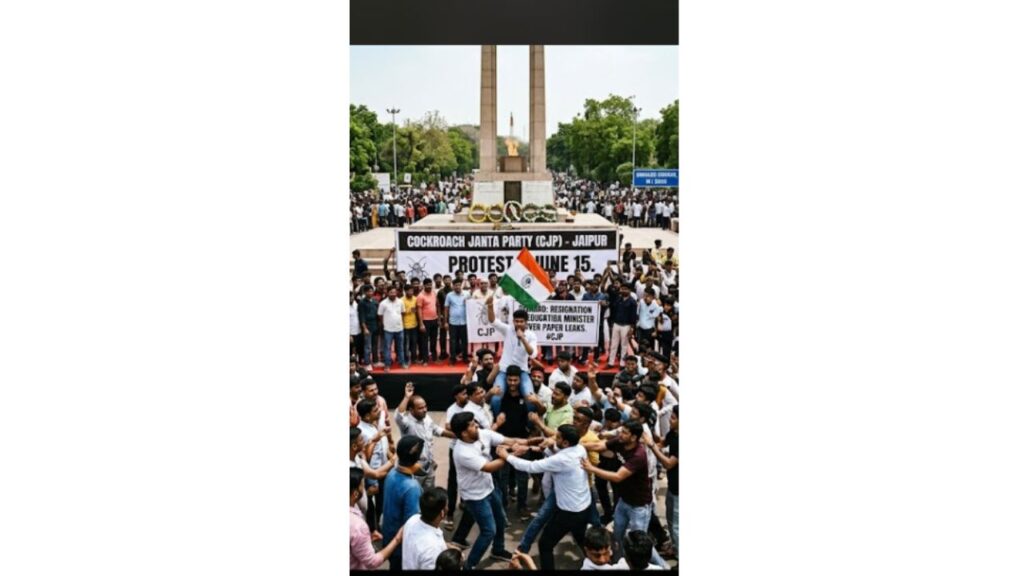
3. The Philosophy of Non-Violent Resistance Under Direct Physical Provocation
The real significance of the event shifted dramatically in the immediate moments after the CJP founder slapped by the infiltration team. As news of the physical assault rippled through the immediate perimeter, a wave of profound anger washed over the gathered CJP loyalists. Several student activists immediately retaliated, capturing the main attackers and engaging in a highly volatile physical altercation. The protest venue was on the absolute brink of transforming into a widespread, uncontrollable civil riot that could have resulted in mass injuries and severe legal crackdowns on the student movement.
By consciously choosing to prioritize moral resilience over physical retaliation immediately after the world watched the CJP founder slapped, Dipke successfully executed a massive tactical transformation of his public image. He deliberately leveraged the immediate shock value of the physical violence to expose the intellectual bankruptcy of his political opponents. In a highly articulated statement released on X (formerly Twitter) later that evening, Dipke asserted that when an establishment resorts to sending agents to ensure a peaceful CJP founder slapped in broad daylight, it is an explicit, undeniable admission that they have completely lost the logical and philosophical argument regarding the future of the nation’s youth.
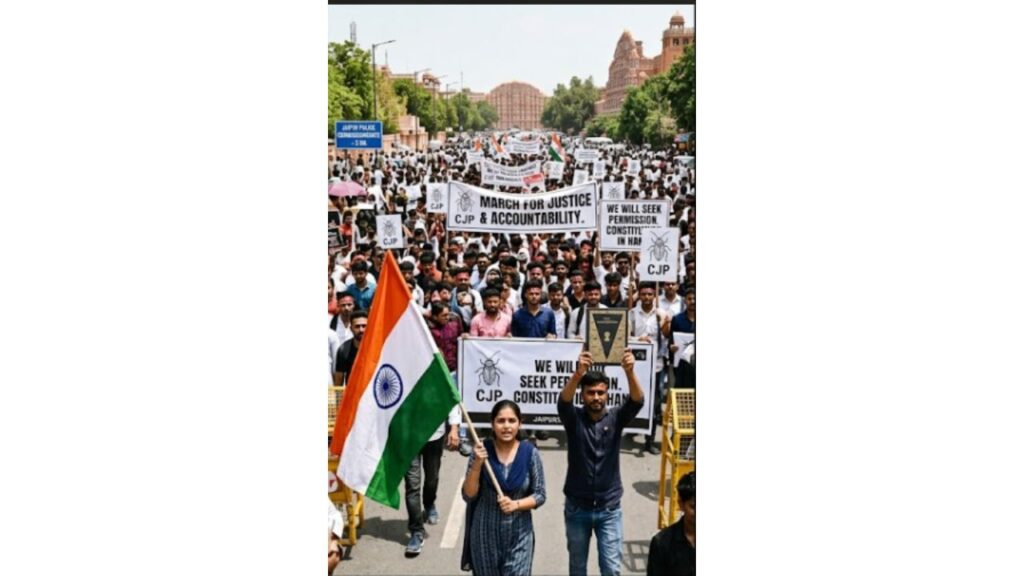
4. Law Enforcement Interventions, Arrests, and the Conspiracy Narrative
The Jaipur Police department, facing immense immediate pressure as videos of the CJP founder slapped dominated digital feeds, moved quickly to establish a semblance of legal order. Five primary individuals at the center of the physical assault were swiftly separated from the angry crowd and taken into protective custody. They were formally booked under Section 170 of the Bharatiya Nagarik Suraksha Sanhita (BNSS), which pertains to preventive detention and the maintenance of public order during scheduled public assemblies. The individuals were identified in official police records as Rohit Sharma, Rakesh Gurjar, Ajay Sharma, Kuldip Singh, and Niket.
During initial administrative interrogations, one of the detained advisers boldly proclaimed to investigators that he had targeted the CJP leadership because he genuinely believed their satirical campaigns were actively “misleading the innocent public” and creating artificial panic around national educational institutions. However, the CJP’s legal cell and central executive committee immediately rejected this narrative of spontaneous citizen anger. The party released a series of highly detailed digital dossiers linking the arrested individuals directly to regional student wings of established ruling political parties. The CJP asserts that the event where the CJP founder slapped was a calculated, pre-planned state-sponsored conspiracy designed specifically to intimidate the leadership, sabotage the gathering, and create an atmosphere of physical terror that would discourage ordinary, middle-class parents from allowing their children to participate in upcoming nationwide anti-paper leak agitations.
5. Strategic Amplification: How Physical Intimidation Transformed the Movement
From a purely tactical perspective, the political strategists who engineered the scenario where the CJP founder slapped made a monumental miscalculation. In the complex landscape of modern political communication, physical violence directed against a non-violent, media-savvy leader almost always functions as an accidental accelerant for their cause. Prior to the shocking day when the CJP founder slapped at Shaheed Smarak, mainstream legacy television channels had largely minimized the CJP’s street presence, occasionally dismissing them as an amusing but minor online phenomenon driven solely by internet-fluent urban youth.
The undeniable shock value of seeing the CJP founder slapped completely changed that media dynamic overnight. Prime-time news anchors who had previously ignored the CJP’s highly detailed policy documents on educational reform suddenly dedicated entire multi-hour debate segments to analyzing the Jaipur incident. Consequently, this massive wave of mainstream coverage brought unprecedented national visibility to the CJP’s core demands, including a complete, independent judicial audit of national testing bodies, the creation of non-bailable criminal statutes for administrative paper leaks, and immediate state support systems for families affected by examination irregularities. The image of the CJP founder slapped became an instant national symbol of institutional overreach, drawing widespread sympathy from diverse demographics far beyond the party’s initial digital subscriber base.
Conclusion: The Long-Term Impact on Democratic Dissent
The dramatic, highly publicized incident where the CJP founder slapped at Shaheed Smarak will undoubtedly be remembered as a true watershed moment in the evolving history of Indian youth movements. It marks the precise historical juncture where a political entity that was born entirely as an online, artificial-intelligence-driven satirical meme officially completed its arduous transformation into a potent, resilient, boots-on-the-ground grassroots political force capable of unsettling entrenched institutional structures. By responding to an act of blatant physical intimidation with a calm, deeply philosophical commitment to non-violent democratic resistance, Abhijeet Dipke has fundamentally altered the dynamics of contemporary student protest.
Frequently Asked Questions (FAQs)
Q1: What exactly occurred during the incident where the CJP founder slapped in Jaipur?
On June 15, 2026, during a massive youth rally organized at Shaheed Smarak to protest national examination leaks, the CJP founder slapped multiple times across his face by a group of five counter-protesters who managed to breach the core security line while he was hoisted on the shoulders of his student supporters.
Q2: Who is the individual identified as the CJP founder?
The individual at the center of the movement is Abhijeet Dipke, a thirty-year-old digital communications strategist, journalist, and public relations alumnus of Boston University who founded the Cockroach Janta Party (CJP).
Q3: Why was the CJP founder slapped according to the arrested attackers?
According to preliminary law enforcement statements, the main assailant claimed the CJP founder slapped because his satirical political campaigns and street agitations were allegedly “misleading the general public” regarding the integrity of national competitive testing agencies.
Q4: What official legal actions were taken after the CJP founder slapped incident?
Jaipur Police arrested five distinct individuals under Section 170 of the Bharatiya Nagarik Suraksha Sanhita (BNSS) for preventive detention and public disruption immediately after the public witnessed the CJP founder slapped.
Q5: What are the primary structural demands of the CJP following the assault?
Following the incident where the CJP founder slapped, the organization has intensified its core demands, which include the immediate resignation of the Union Education Minister, a full overhaul of national examination bodies, and strict non-bailable laws against administrative paper leaks.