
The corridors of India’s apex court are accustomed to rigorous legal arguments, historic judgments, and high-stakes constitutional debates. However, the legal and social landscape of the country witnessed a massive shockwave following a highly controversial verbal observation made from the bench. Legal scholars, journalists, and everyday citizens were left asking a singular, burning question: why youth called cockroaches in supreme court?
The phrase instantly ignited furious debates across social media, leading to national outrage, political satire, and intense public scrutiny over judicial vocabulary. To fully understand why youth called cockroaches in supreme court, one must dive deep into the specific court case, the exact context of the remarks, the immediate institutional fallout, and the subsequent explanation provided by the bench.
The Spark: What Happened inside the Courtroom?
On May 15, 2026, a Supreme Court bench comprising Chief Justice of India (CJI) Surya Kant and Justice Joymalya Bagchi assembled to hear a seemingly routine matter. The petition in question involved a lawyer who was aggressively pursuing a legal direction to compel the Delhi High Court to designate him as a “Senior Advocate.”
During the heated exchange, the bench severely reprimanded the petitioner for his unprofessional conduct, pointing specifically to the aggressive and questionable language he had used on social media platforms like Facebook.why youth called cockroaches in supreme court The bench remarked that the title of a Senior Advocate is an honor conferred by the court based on merit and tradition, not a status symbol to be chased or demanded through aggressive litigation.
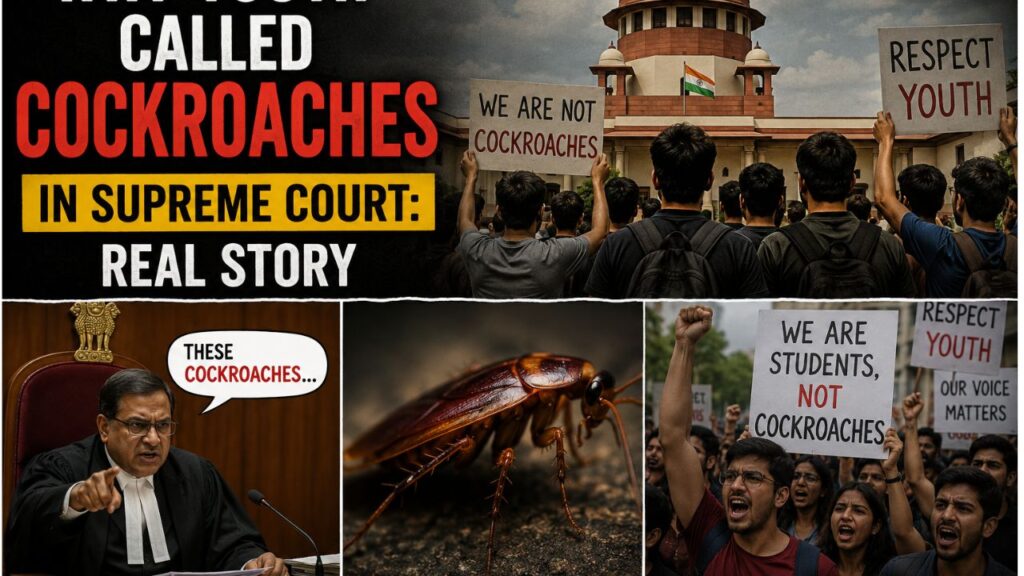
As the courtroom tension flared, oral observations were made comparing individuals who aggressively attack public institutions online to pests. It was during this specific dressing-down of the lawyer’s online behavior that the controversial phrase entered the public record, forcing citizens to look up why youth called cockroaches in supreme court.

Deconstructing the Remark: The Exact Words Used
According to media reports and court observers present during the session, the Chief Justice expressed deep frustration with how public platforms were being used to badger the judiciary. In an attempt to illustrate how individuals without proper professional standings utilize public avenues to launch frivolous attacks against the system, the bench used highly provocative metaphors.
The exact reported text that made the public wonder why youth called cockroaches in supreme court was as follows:
This statement associated lack of employment, youth, and public-interest tools—such as the Right to Information (RTI) Act—with societal pests. The immediate result was a firestorm of criticism, as citizens wondered why the head of the nation’s final guardian of dignity would choose words heavily loaded with dehumanizing undertones.
The Root Cause: Why Youth Called Cockroaches in Supreme Court
To pinpoint exactly why youth called cockroaches in supreme court, we have to separate the immediate emotional reaction from the underlying institutional anxiety the court was trying to address. The primary catalyst behind the remark was a broader frustration with three specific trends:
1. The Proliferation of Fake and Bogus Degrees
During the very same hearing, the Supreme Court raised serious alarms regarding the authenticity of qualifications within the legal community. The bench noted that a substantial number of individuals wearing black coats in Delhi might be operating under completely fake law degrees.why youth called cockroaches in supreme court The CJI even hinted at wanting the Central Bureau of Investigation (CBI) to step in and audit these qualifications, lamenting that the Bar Council of India frequently fails to act because “they need their votes.”
2. The Rise of “System Attackers” on Social Media
The bench was expressing institutional exhaustion regarding individuals who utilize digital channels to deliberately undermine public trust in government and judicial bodies. In the court’s view, when individuals fail to build a legitimate career within traditional systems, they occasionally weaponize alternative avenues like YouTube channels, independent media outlets, or social media handles to target and bully institutional figures.why youth called cockroaches in supreme court
3. Frivolous Public Interest Litigations (PILs)
The bench felt that the legal process was being corrupted by individuals using courtrooms for self-promotion rather than genuine legal grievances. The specific petitioner’s aggressive chase for an ornamental status symbol symbolized a larger, frustrating pattern of people misusing the legal architecture.
The Immediate Clarification: “Misquoted by the Media”
As the public backlash intensified overnight, the Chief Justice of India issued an urgent institutional clarification on May 16, 2026, to directly explain why youth called cockroaches in supreme court reports had circulated.
The CJI expressed deep pain over how his oral observations were interpreted, claiming that sections of the media had wildly misquoted his words and stripped them of their proper legal context.
The top judge firmly asserted that it was completely incorrect to claim he was attacking the young demographic of India. He noted that he views the youth as the definitive pillars of a developed India and holds them in the highest regard. According to the official clarification, the “cockroach” and “parasite” labels were directed strictly at individuals who rely on fraudulent credentials to infiltrate noble professions, not regular, hard-working, or genuinely unemployed young people.why youth called cockroaches in supreme court
The Satirical Pushback: Rise of the “Cockroach Janta Party”
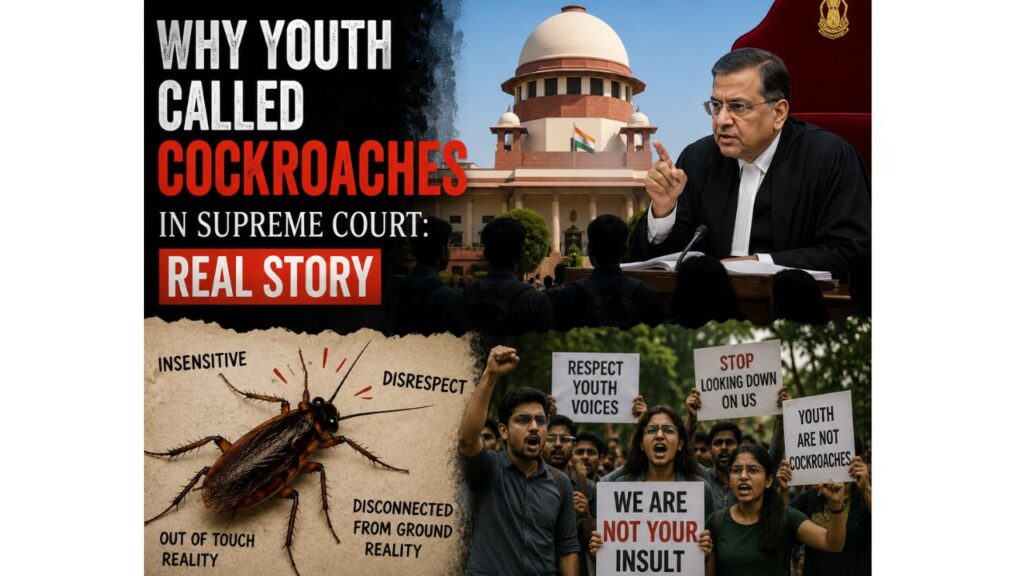
Despite the prompt clarification issued by the bench, the controversial phrase took on a life of its own in popular culture. It tapped into a deep well of generational anxiety regarding systemic unemployment, paper leaks, and exam cancellations that young Indians were already grappling with.
In response to learning why youth called cockroaches in supreme court, an international student and political communications strategist named Abhijeet Dipke launched a satirical political movement on May 16, 2026, called the Cockroach Janta Party (CJP).
What began as a viral joke on social media transformed into a massive youth campaign. Within weeks, the parody party achieved over 350,000 official sign-ups and amassed over 20 million followers on Instagram. The movement embraced the “cockroach” label as a badge of honor, humorously defining their membership criteria around being “chronically online,” “unemployed by force or choice,” and “professionally capable of online ranting.”why youth called cockroaches in supreme court
Prominent public figures, including environmentalist and educator Sonam Wangchuk, joined in by declaring themselves “honorary cockroaches,” urging the administrative organs of the state to constructively look into youth grievances rather than dismissing digital dissent as a parasitic attack.why youth called cockroaches in supreme court
Historical Context: The Power and Danger of Dehumanizing Metaphors
When analyzing why youth called cockroaches in supreme court, historians and sociologists raised grave alarms because of the dark historical weight behind insectoid metaphors. Calling human groups “vermin,” “termites,” or “cockroaches” has historically been a tool used to strip away empathy from vulnerable groups.
| Historical Era / Context | Metaphor Deployed | Societal Impact |
|---|---|---|
| Rwanda (1994 Genocide) | Inyenzi (Cockroaches) | Dehumanized the Tutsi minority across radio broadcasts, lowering the psychological barrier to violence. |
| Global Authoritarian Regimes | Parasites / Disease | Frames dissenting voices, journalists, or minorities as infections attacking a healthy national body. |
| Modern Democratic Discourse | Insects / Pests | Used casually by political or judicial elites to invalidate public critique, RTI activists, and alternative media. |
why youth called cockroaches in supreme court Legal analysts pointed out that while a judge may use metaphoric language to convey institutional anxiety regarding procedural disorder, using such phrases from the highest constitutional bench sends a dangerous signal to lower courts and administrative officers regarding how they should treat citizens who voice grievances or file RTI queries.
Conclusion
The massive national controversy surrounding why youth called cockroaches in supreme court highlights the delicate boundary between a judge’s casual oral remarks and the massive societal weight those words carry. While the official clarification established that the comments were narrowly targeted toward professionals holding fake degrees rather than the actual youth of the country, the incident exposed raw generational wounds concerning economic stability, unemployment, and institutional trust.
The subsequent birth of satirical movements like the Cockroach Janta Party proved that the younger generation will actively use digital humor and solidarity to push back against language they perceive as unfair. Ultimately, this courtroom event serves as a historic reminder that in a constitutional democracy, every word spoken by the guardians of justice is measured against the foundational promise of human dignity.
Frequently Asked Questions (FAQs)
Q1: What is the main reason behind why youth called cockroaches in supreme court?
The initial phrase arose during a heated Supreme Court hearing where the bench was expressing intense frustration with a lawyer’s unprofessional conduct on social media. The court used the metaphor to describe individuals who, lacking traditional professional success, supposedly turn to alternative media, social media, and activism to aggressively attack established institutions.
Q2: Did the Supreme Court actually target all unemployed young people?
According to the official clarification issued by Chief Justice Surya Kant, the court did not target the youth of the nation. The judge clarified that the oral observations were aimed exclusively at individuals using fake or bogus degrees to sneak into noble fields like the legal profession, media, and social work.
Q3: What case was being heard when this statement was made?
The remarks were made during a contempt plea regarding the process of designating a lawyer as a “Senior Advocate” in the Delhi High Court. The Supreme Court bench dismissed the petition as frivolous, citing the lawyer’s inappropriate professional and social media conduct.
Q4: What was the Cockroach Janta Party (CJP)?
The Cockroach Janta Party was a viral, satirical youth movement founded by Abhijeet Dipke in May 2026. It was created as a direct parody response to the Supreme Court’s “cockroach” comment, converting the derogatory term into a massive online movement representing the anxieties of unemployed and digitally active young Indians.
Q5: Why did the comment trigger so much public outrage?
The public was outraged because words like “cockroaches” and “parasites” carry a dark historical association with dehumanization. Critics felt that such vocabulary is completely inappropriate for the supreme custodians of constitutional rights, especially at a time when young people were already highly stressed due to job scarcity and competitive exam scandals.
To gain a deeper perspective on this judicial event, this broadcast covers the widespread public backlash and analyzes the specific legal exchanges that led to the top court’s controversial remarks:
CJI Referred to Youngsters as Cockroaches During a Hearing | WION News
The video offers an in-depth journalistic breakdown of how the controversial oral observations were delivered from the bench and examines the initial wave of public and institutional reactions that swept the nation right after the session closed.