
The global beauty market has shifted dramatically over the last few years. Driven by an unprecedented wave of conscious consumerism, ethical production, and environmental awareness, plant-based formulations are no longer a niche trend. By 2026, the global vegan cosmetics market is projected to skyrocket past $19 billion. For individuals dealing with chronic skin reactivity, redness, or conditions like rosacea and eczema, this shift raises a crucial question: Are Vegan Cosmetics Ingredients genuinely better for sensitive skin, or is this simply brilliant greenwashing?
To truly understand if choosing Vegan Cosmetics Ingredients will soothe your hyper-reactive skin or trigger an unwanted flare-up, we have to look past the attractive packaging and examine the formulation science.
Understanding the True Meaning of Vegan Beauty
Before analyzing how these formulations affect a compromised skin barrier, we need to establish exactly what a vegan label means—and what it does not mean.
A product utilizing Vegan Cosmetics Ingredients guarantees one specific standard: it is completely free from animal-derived ingredients, animal by-products, and animal-processed compounds.
To better navigate your product labels, it is helpful to look at how traditional animal-derived staples are replaced by ethical alternatives:
| Traditional Animal Ingredient | Sourced From | Vegan Cosmetics Ingredients Alternative |
| Carmine | Crushed cochineal beetles (used for red pigment) | Iron oxides, beet juice extract, or synthetic pigments |
| Lanolin | Sheep’s wool grease (deeply hydrating emollient) | Shea butter, jojoba oil, or plant-derived squalane |
| Beeswax | Honeybee structures (used as a thickener/barrier) | Candelilla wax, carnauba wax, or sunflower seed wax |
| Collagen | Animal connective tissues (cows, fish, or horses) | Plant amino acids or yeast-derived/precision-fermented collagen |
| Glycerin (Animal) | Rendered animal fats | Vegetable glycerin (derived from soy, coconut, or palm) |
The Common Marketing Misconceptions
Many consumers automatically assume that a product utilizing Vegan Cosmetics Ingredients is inherently 100% natural, clean, organic, and cruelty-free. However, from a regulatory and scientific perspective, these terms are distinct:
- Vegan vs. Cruelty-Free: A product can feature purely Vegan Cosmetics Ingredients but still be tested on animals in regions where law requires it. Conversely, a product can be certified cruelty-free (never tested on animals) while containing animal ingredients like honey or carmine.
- Vegan vs. Natural: A vegan formula can be entirely synthetic. Lab-grown ingredients, synthetic preservatives, and petroleum derivatives are fully vegan because they do not involve animals.
- Vegan vs. Hypoallergenic: This is the most critical distinction for sensitive skin. A “vegan” stamp is an ethical classification, not a dermatological safety guarantee.
Why Vegan Cosmetics Ingredients Can Benefit Sensitive Skin
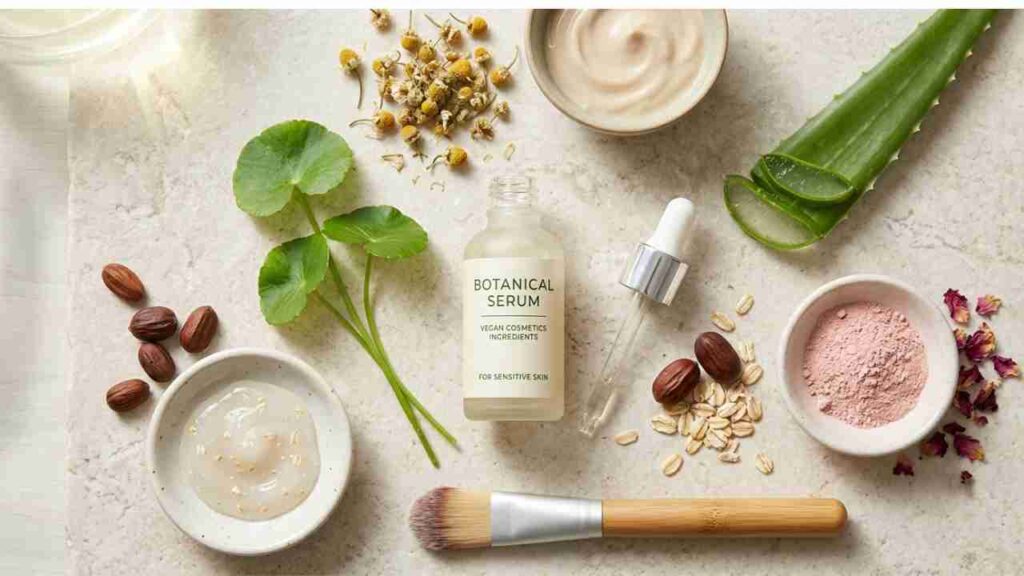
For many people, introducing targeted Vegan Cosmetics Ingredients into their daily regimen provides noticeable relief. When formulated thoughtfully, plant-based and biotech alternatives offer distinct advantages for a reactive skin barrier.
1. Elimination of Common Animal-Derived Irritants
Traditional cosmetics frequently rely on animal industrial by-products that are notorious for triggering contact dermatitis. Carmine, the vibrant red pigment found in conventional blushes and lipsticks, is a known allergen that frequently causes redness and itching around the eyes and lips.
Lanolin, while a highly effective emollient for dry skin, contains complex proteins that can trigger allergic reactions in prone individuals. By building a routine around Vegan Cosmetics Ingredients, you completely remove these specific allergens from your daily exposure list.
2. High Concentration of Natural Antioxidants and Anti-Inflammatory Compounds
High-quality Vegan Cosmetics Ingredients derived from botanicals often come naturally packed with secondary metabolites that actively soothe irritated skin.
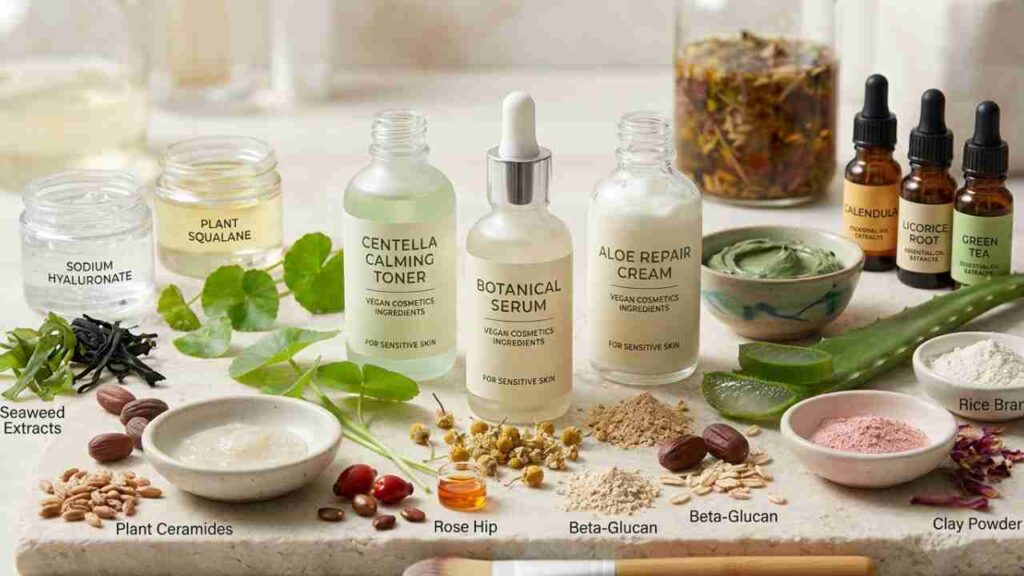
Ingredients like Centella Asiatica (Gotu Kola), green tea extract, chamomile, and aloe vera do more than just hydrate. They contain high concentrations of polyphenols and calming agents that reduce redness, suppress inflammatory pathways, and help cool down the stinging sensations characteristic of hyper-sensitive skin.
3. Structural Synergy with the Skin’s Lipids
Many plant oils used in vegan beauty closely mirror the sebum naturally produced by our skin. Jojoba oil, for instance, is technically a liquid wax ester that is structurally almost identical to human sebum.
Additionally, plant-derived squalane (sourced from olives or sugarcane) acts as a beautiful bio-identical match to the squalene found in our skin barrier. These Vegan Cosmetics Ingredients sink into the skin effortlessly, reinforcing the lipid matrix without clogging pores or triggering a reactive immune response.
The Hidden Risks: When Vegan Ingredients Trigger Sensitivity
Despite the clear benefits, switching to a plant-based routine is not a magic fix for reactive skin. In fact, a recent study published in JAMA Dermatology revealed that over 94% of cosmetic products marketed as “natural” or “clean” contained at least one known skin allergen.
When it comes to Vegan Cosmetics Ingredients, several factors can unintentionally provoke sensitive skin:
The Danger of Essential Oils and Natural Fragrances
To avoid synthetic perfumes, many vegan brands use essential oils like lavender, peppermint, ylang-ylang, bergamot, and tea tree oil to scent their products.
Biologically Active Botanicals
Plants produce natural chemicals to defend themselves against insects and harsh weather. When these raw, unrefined extracts are packed into skincare in high percentages, they can overstimulate human skin. Just because an ingredient grows out of the soil does not mean your face wants to process its complex chemical structure.
Synthetic Vegan Chemicals
As established, many Vegan Cosmetics Ingredients are made in a laboratory. While synthetic ingredients are often incredibly stable and pure, certain vegan-friendly synthetic preservatives (like phenoxyethanol or certain parabens) or harsh surfactants (like Sodium Lauryl Sulfate) can still cause burning or dryness if the overall formula is unbalanced.
How to Screen an Ingredient List for Sensitive Skin
If you want to enjoy the ethical advantages of Vegan Cosmetics Ingredients without compromising your skin health, you must learn to read the back of the bottle like a cosmetic chemist.
What to Look For (The Safe Zone)
When scanning your products, look for minimalist formulations that prioritize these soothing, stable, and protective Vegan Cosmetics Ingredients:
- Oat Beta-Glucan / Colloidal Oatmeal: Phenomenal for repairing a broken skin barrier and stopping itchiness.
- Allantoin: A gentle compound derived from the comfrey plant that speeds up skin healing.
- Vegetable Glycerin & Hyaluronic Acid (Fermented): Pure, non-irritating humectants that bind water to the skin.
- Ceramides (Plant-Derived): Essential lipids that glue your skin cells together, locking in moisture and keeping irritants out.
What to Avoid (The Red Flags)
If your skin flushes easily, scan the ingredient deck and steer clear of products containing these items alongside your Vegan Cosmetics Ingredients:
1.Check for Essential Oils:First 5-10 ingredients.
Scan the middle and top of the list for names like Lavandula Angustifolia (Lavender), Mentha Piperita (Peppermint), or Citrus oils. If present, pass on the product.
2.Identify Alcohol Content:Look for drying agents.
Ensure Denatured Alcohol, SD Alcohol, or Isopropyl Alcohol are not near the top of the list, as they strip the lipid barrier.
3.Verify Fragrance Status:Check the very bottom.
Look for the words “Fragrance”, “Parfum”, or known fragrance allergens like Linalool, Limonene, or Geraniol. True sensitive-skin products should be entirely fragrance-free.
The Verdict: Are Vegan Cosmetics Ingredients Truly Better?
Ultimately, Vegan Cosmetics Ingredients are not automatically better for sensitive skin solely because they are vegan. The true safety of a product depends entirely on its overall formulation balance, the molecular stability of its actives, and the absence of known irritants.
If you choose a vegan product that is completely fragrance-free, clinically tested, and focused on simple barrier-repairing botanicals (like oat, green tea, and plant squalane), it can be incredibly beneficial for sensitive skin. However, if you choose a poorly formulated product loaded with unrefined plant extracts and volatile essential oils, your skin will likely react negatively, despite the formula’s ethical credentials.
To introduce new products safely, always perform a patch test on your inner forearm or behind your ear for 72 hours before applying it to your face.
Frequently Asked Questions
Can vegan cosmetics ingredients cause allergic reactions?
Yes. Plant-based ingredients like nut oils, soy derivatives, and botanical extracts are common allergens. Furthermore, natural fragrances and essential oils frequently found in vegan formulas are leading triggers for contact dermatitis and skin irritation.
What is the difference between vegan and clean beauty?
“Vegan” explicitly means a product contains zero animal-derived components. “Clean beauty” is an unregulated marketing term that typically implies a product avoids ingredients perceived as harmful or toxic (such as sulfates, parabens, and phthalates), though it may still contain animal products like honey or silk.
How can I be absolutely certain a cosmetic product is truly vegan?
Do not rely solely on the word “vegan” printed on the front of packaging. Look for official third-party certifications on the back of the label, such as the Vegan Society trademark, Certified Vegan (Vegan Action), or V-Label logos. These organizations independently audit the supply chain to ensure compliance.
Are synthetic ingredients in vegan cosmetics safe for reactive skin?
Yes, often they are safer than raw natural alternatives. Synthetic Vegan Cosmetics Ingredients created in controlled laboratory environments are stripped of impurities, highly stable, and systematically tested. This predictability makes them less likely to trigger unexpected immune or allergic reactions than complex, unrefined plant botanicals.
Does “cruelty-free” mean a product contains only vegan cosmetics ingredients?
No. Cruelty-free means that neither the final cosmetic product nor its individual components were tested on animals during development. The formulation itself may still heavily feature animal-derived ingredients such as carmine, beeswax, or lanolin.
Why do some vegan cosmetics irritate my face instantly?
Immediate burning, itching, or redness is typically caused by a compromised skin barrier reacting to volatile ingredients like essential oils, citrus extracts, drying alcohols, or concentrated natural acids. When the skin barrier is weak, these ingredients penetrate too deeply and overstimulate the nerve endings.
The global beauty market has shifted dramatically over the last few years. Driven by an unprecedented wave of conscious consumerism, ethical production, and environmental awareness, plant-based formulations are no longer a niche trend. By 2026, the global vegan cosmetics market is projected to skyrocket past $19 billion. For individuals dealing with chronic skin reactivity, redness, or conditions like rosacea and eczema, this shift raises a crucial question: Are Vegan Cosmetics Ingredients genuinely better for sensitive skin, or is this simply brilliant greenwashing?
To truly understand if choosing Vegan Cosmetics Ingredients will soothe your hyper-reactive skin or trigger an unwanted flare-up, we have to look past the attractive packaging and examine the formulation science.